
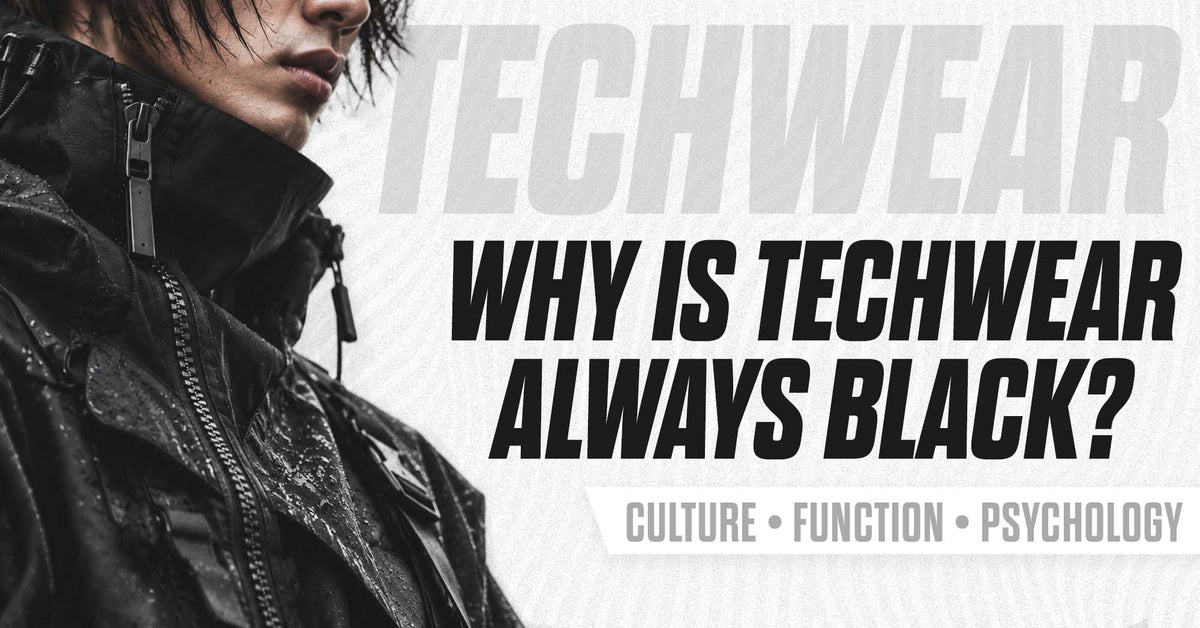
Why Is Techwear Always Black? The Color Philosophy Explained
Walk into any techwear community and you'll notice the same thing almost instantly: the overwhelming majority of outfits are built around black. Not exclusively, but dominantly, with charcoal, olive or graphite as the usual supporting cast. It's rarely a random choice, and it's not just a trend that caught on and never left.
The dominance of black in techwear comes down to a mix of cultural influences, practical trade-offs, and psychology, and understanding why makes it a lot easier to build a cohesive wardrobe instead of guessing at what "looks techwear" and what doesn't.
This isn't a rule someone wrote down once and everyone followed blindly, either. It's a palette that kept winning out over the alternatives brands tried, for reasons that hold up whether you look at it from a design, a maintenance, or a psychological angle, even if none of those reasons is absolute on its own.
One thing worth being upfront about: black is a styling choice, not a performance feature or a requirement. No technical fabric works better because it happens to be dyed black, and a jacket doesn't become more waterproof or more durable by being darker. The color sits on top of the engineering, shaped by culture, practicality and psychology, but it isn't the engineering itself, and treating it that way would be selling techwear on something it doesn't actually deliver.
The Cultural Roots of Black in Techwear

Japanese Streetwear and Minimalist Design
Techwear as a movement owes a lot to Japanese fashion, where restraint and precision are treated as design values in their own right. Concepts like wabi-sabi favor understated, muted palettes over anything loud. It's worth being precise here: this philosophy didn't literally dictate techwear's color chart, but it's a well-documented aesthetic parallel that likely shaped the restrained, muted direction the style took as it developed.
Black became the default because it lets the cut, silhouette and functional details of a garment do the talking, instead of competing with color. A jacket with articulated sleeves, taped seams and modular pockets reads as intentional in black; the same garment in bright orange reads closer to a costume.
Cyberpunk and Dystopian Fiction's Influence
Techwear also borrows heavily from cyberpunk and dystopian visual culture, where dark, monochrome cities and characters dressed head-to-toe in black became shorthand for a near-future aesthetic. Films and games set in rain-soaked, neon-lit metropolises reinforced the idea that black clothing belongs in an urban, technological environment.
That visual language stuck around, and it's a big part of why darkwear and techwear overlap so often in the same outfits, even if the two scenes have distinct histories rather than one being a direct descendant of the other.
Utility and Military Workwear Influence
Alongside those aesthetic roots, techwear also carries a practical lineage from military surplus and utility workwear, where dark, low-visibility tones were chosen for functional reasons long before techwear existed as a named scene. That's not a documented one-to-one influence on any specific brand, but the overlap in logic, dark and neutral because it's practical, is hard to ignore when you look at where cargo pockets, adjustable straps and modular pouches actually come from.
The Functional Reasons Behind the Black Palette

Practicality in Urban Environments
To be clear, none of what follows means black makes a fabric perform better. What it does affect is how the garment behaves in daily use, which is a maintenance and appearance question, not a performance one. Black hides everyday dirt, dust and light staining far better than pale colors, which matters when a jacket or a pair of cargo pants is being used daily in a city rather than kept pristine in a closet.
That said, black isn't immune to the downsides of dark fabric, and a techwear article shouldn't pretend otherwise. UV light breaks down dye molecules through a process called photo-oxidation regardless of the color underneath, so black garments do fade over time, and heat speeds that reaction up. Dark fabric also absorbs more heat from direct sunlight than light fabric does, which is a real trade-off worth knowing if you're wearing techwear outdoors in summer, not just a footnote.
Pairing and Modularity
A core idea in techwear is modularity: pieces should be interchangeable so a jacket, pants, vest and bag all work together regardless of the combination. Black, and other neutral dark tones, makes that mixing effortless. There's no color-matching to think about, no risk of clashing, and every new piece added to the wardrobe is automatically compatible with everything already owned.
This matters more in techwear than in most other styles, because the whole point of the aesthetic is being able to layer and swap components on the fly. A restrictive color palette would undercut that flexibility immediately.
Techwear Color Palette at a Glance

Black leads, but it's not acting alone. Here's how the full techwear palette typically breaks down and where each tone tends to show up:
| Tone | Role in the Outfit | Common Pieces | Why It Works |
|---|---|---|---|
| Black | Dominant base color | Jackets, pants, hoodies, bags | Neutral, hides everyday wear, lets silhouette and function stand out |
| Charcoal / Graphite | Soft contrast to black | Base layers, t-shirts, liners | Adds depth without breaking the dark palette |
| Olive Drab | Utilitarian accent | Cargo pants, vests, field jackets | Reads as functional and military-adjacent, still neutral |
| Navy / Deep Blue | Occasional base alternative | Coats, shirts | Dark enough to blend with black, adds subtle variation |
| Reflective / Silver | Functional accent only | Piping, zipper pulls, logo trim | Improves low-light visibility without adding real color |
The Psychology of Black in Techwear
Authority, Anonymity and Stealth
Black carries psychological weight that lighter colors don't. It reads as controlled and low-profile, which fits the techwear identity of someone who moves through a city with purpose rather than trying to stand out. There's also an element of anonymity to it: an all-black outfit blends into low light and crowds instead of drawing attention, a bit like the "grey man" idea used in security and travel circles, where clothing that doesn't announce anything about you lets you move through any environment without friction.
Common Mistakes When Adding Color to a Techwear Fit
If you want to introduce color without breaking the aesthetic, avoid these common missteps:
- Using saturated primary colors — bright red, blue or yellow immediately clash with the restrained, technical feel the style is built on.
- Mixing warm and cool blacks — not all "black" garments are the same shade; pairing a warm black with a cool black under direct light can look mismatched.
- Letting an accent color dominate — a colored zipper or strap should stay a small detail, not become the focal point of the outfit.
- Ignoring lighting conditions — a color that looks subtle indoors can read as loud in daylight, so test any accent piece outside before committing.
- Adding color to more than one piece at a time — one accent reads as intentional, two or three competing accents just looks unplanned.
How to Style an All-Black Techwear Look

Layering Different Shades and Textures
The trick to making an all-black outfit look put-together instead of flat is varying the shade and material, not the color itself. Pair a matte cotton-blend hoodie with a glossy shell jacket, or a ribbed base layer under structured techwear pants. The contrast in texture creates visual depth that a single flat black piece can't.
Adding Depth Without Color
Layering itself does a lot of the work too. A techwear jacket over a vest, over a long-sleeve base, naturally creates shadow and dimension across the outfit. Finishing with a functional accessory like a chest bag or a utility belt adds another layer of visual interest without breaking the palette.
A simple process to follow when building a fit from scratch:
- Start with a base layer in matte black or charcoal for warmth and structure.
- Add a mid layer with a different texture, like a ribbed fleece or technical knit, to break up the flatness.
- Finish with an outer shell or vest that has visible functional details (straps, zippers, seams) so the outfit reads as engineered rather than plain.
Wearing Black Techwear Through the Seasons

Managing Heat in Summer
Because dark fabric absorbs more heat than light fabric, an all-black outfit can feel noticeably warmer in direct summer sun. If you're wearing techwear through a hot season, look for pieces with mesh ventilation panels or lightweight breathable base layers, or swap a black outer shell for one of the muted alternatives from the table above, like a lighter olive or charcoal, on the hottest days.
Layering for Cold Weather
In colder months, that same heat absorption becomes a minor advantage rather than a drawback, since a dark outer shell picks up a little extra warmth from any available sunlight. Pair it with insulating mid layers and a windproof shell to get the most out of it without overheating indoors.
Final Thoughts

Techwear isn't black by accident, but it isn't black without trade-offs either. It's the result of design philosophy, practicality and psychology lining up around the same answer, with heat absorption and fading as the honest exceptions worth knowing. Once you understand why the palette stays dark, and what it costs, building a wardrobe that actually looks cohesive becomes a lot more intuitive.
FAQ on Techwear and the Color Black
Why Is Techwear Always Black?
Techwear favors black mainly because of its ties to minimalist Japanese design and cyberpunk aesthetics, combined with practical benefits like hiding everyday dirt and wear, and the way neutral tones make every piece in a wardrobe interchangeable.
Is Techwear Only Black?
No. Black is the dominant color, but olive, charcoal, navy and muted grey are common too. Bright colors usually only appear as small functional accents, like reflective trim, rather than as a main color.
Is Black a Performance Feature?
No. Black is a styling choice, not a performance feature. A jacket isn't more waterproof, warmer or more durable because it's black; the technical performance comes from the fabric and construction, not the dye color.
Does Black Techwear Fade Faster?
Black hides everyday dirt and light staining better than pale colors, but it isn't immune to fading. UV exposure breaks down dye in any color through photo-oxidation, and heat from direct sunlight speeds that up.
Is Black Techwear Good for Summer?
It works, but it runs warmer than lighter colors because dark fabric absorbs more heat. For hot weather, look for mesh ventilation or breathable base layers, or lean on olive or charcoal instead of full black.
How to Style All-Black Techwear?
Vary the shade and material rather than the color. Mixing matte and glossy fabrics, and layering jackets, vests and base layers, creates depth and contrast while keeping the palette dark.
What Color Should You Add First?
Start with a small, functional accent like reflective piping, a muted olive strap or a graphite base layer rather than a bright saturated color, so the addition still reads as intentional.


Leave a comment
This site is protected by hCaptcha and the hCaptcha Privacy Policy and Terms of Service apply.